Election Math: Majorities, Turnout and Margins
- 1.
The House has 435 seats. What is the smallest number of seats that counts as a majority?
A217B218C200D300 - 2.
The Senate has 100 members and a vote ends 50 to 50. Who breaks the tie?
AThe Speaker of the HouseBThe Chief JusticeCThe vice presidentDThe senator who has served longest - 3.
A county has 120,000 registered voters and 78,000 of them voted. What was the turnout?
A78%B54%C65%D42% - 4.
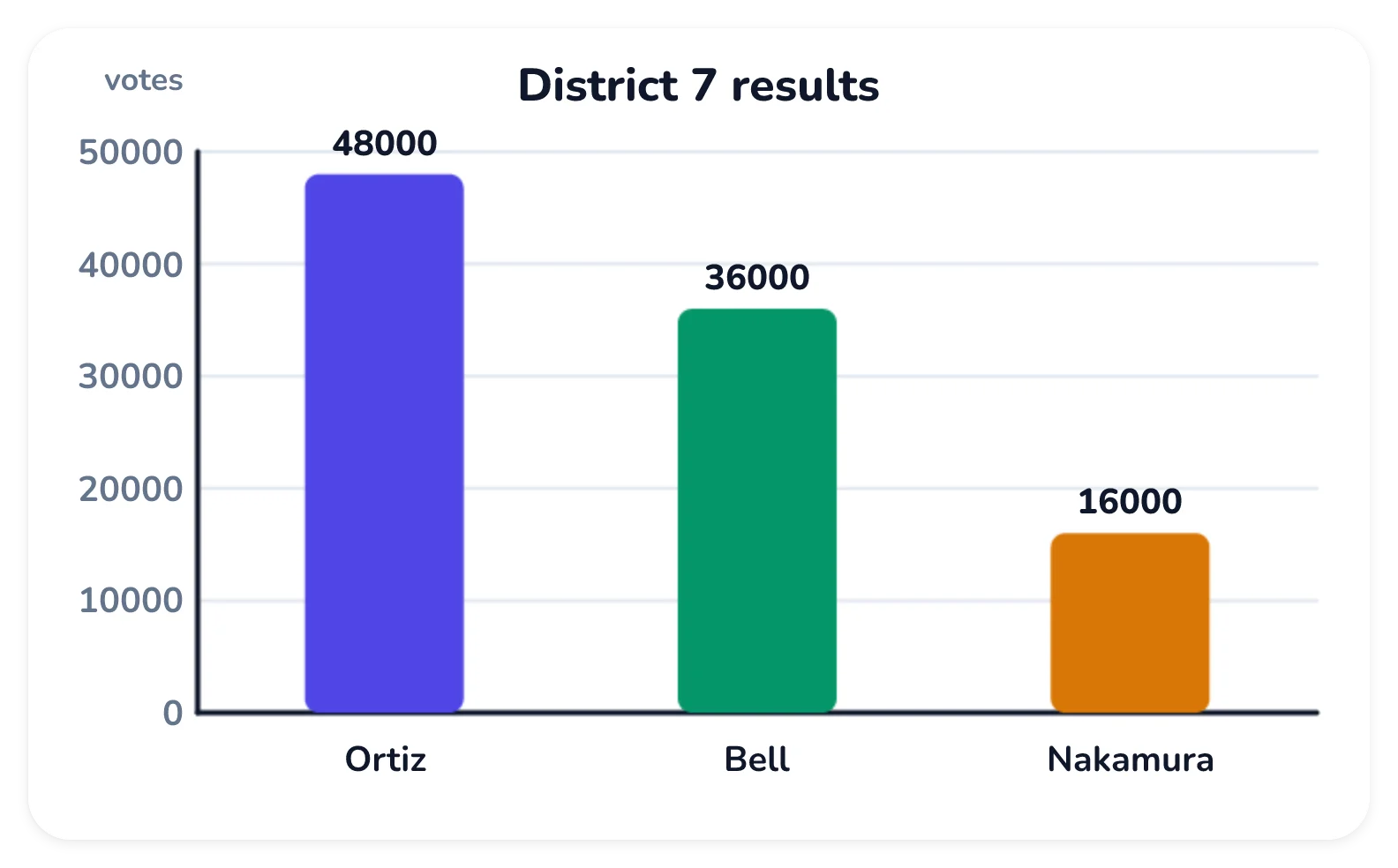
The chart shows the votes in one House district. What percentage of the votes did Ortiz receive?
A36%B52%C60%D48% - 5.
In a governor's race one candidate received 52,300 votes and the other 49,700. What was the margin of victory in votes?
A2,600 votesB3,600 votesC1,300 votesD102,000 votes - 6.
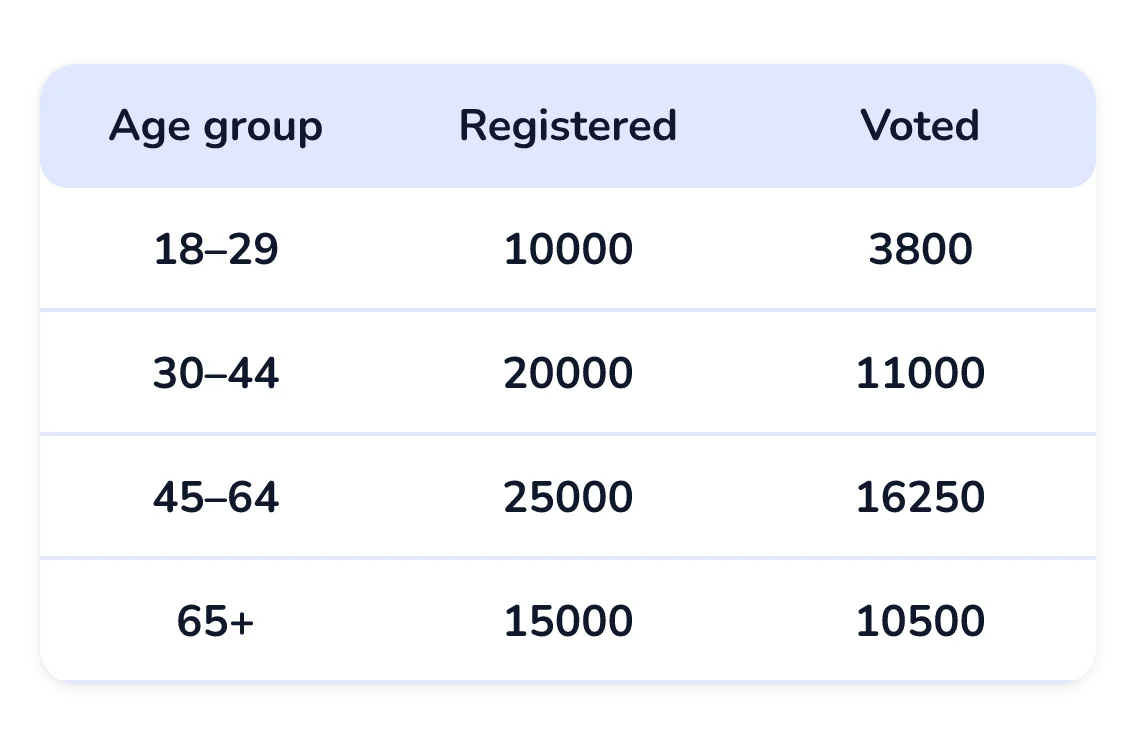
The table shows registered voters and voters who turned out, by age group. What was the turnout for ages 45 to 64?
A55%B65%C38%D70% - 7.
A state with about 39 million people has 52 representatives. About how many people does each representative serve?
AAbout 75,000BAbout 7.5 millionCAbout 750,000DAbout 2 million - 8.
In a midterm year, 33 of the 100 Senate seats are up for election. About what fraction of the Senate is that?
AAbout one halfBAbout one quarterCAbout two thirdsDAbout one third - 9.
Turnout in a town rose from 40% in one midterm to 50% in the next. By how many percentage points did it rise?
A10 percentage pointsB25 percentage pointsC90 percentage pointsD50 percentage points - 10.
With 80% of the votes counted, candidate X leads candidate Y by 4,000 votes. The remaining 30,000 votes split 60% for Y and 40% for X. Who wins, and by how much?
AX, by 4,000 votesBY, by 6,000 votesCY, by 2,000 votesDX, by 2,000 votes
Election Math: Majorities, Turnout and Margins — Answer key
- 1.B — 2182.C — The vice president
- 3.C — 65%4.D — 48%
- 5.A — 2,600 votes6.B — 65%
- 7.C — About 750,0008.D — About one third
- 9.A — 10 percentage points10.C — Y, by 2,000 votes