12 questions
Class 10 Light: Refraction, Lenses and Refractive Index
Class 10 · why light bends, Snell's law and refractive index, images in convex and concave lenses with ray diagrams to read, and the glass slab. CBSE Chapter 9, part 2.
Questions
12 questions in this version · Correct answers are hidden so you can test yourself first.
- 1Question 1
A pencil standing in a glass of water looks bent at the water surface. What causes this?
AReflection of light from the surface of the waterBRefraction of light as it passes from water into airCDispersion of light into colors by the waterDScattering of light by tiny particles suspended in the water - 2Question 2
A ray of light passes obliquely from air into glass. Which way does it bend?
AAway from the normalBIt passes straight through without bendingCTowards the normalDBack into the air - 3Question 3
The refractive index of glass is 1.5 and the speed of light in air is 3 × 10⁸ m/s. What is the speed of light in the glass?
A4.5 × 10⁸ m/sB2 × 10⁸ m/sC1.5 × 10⁸ m/sD3 × 10⁸ m/s - 4Question 4
Which statement is Snell's law of refraction?
AThe angle of incidence is equal to the angle of refractionBThe ratio of the sine of the angle of incidence to the sine of the angle of refraction is a constant for a given pair of mediaCThe incident ray, the refracted ray and the normal at the point of incidence all lie in the same plane, on the same side of the normalDThe refracted ray always bends toward the normal - 5Question 5
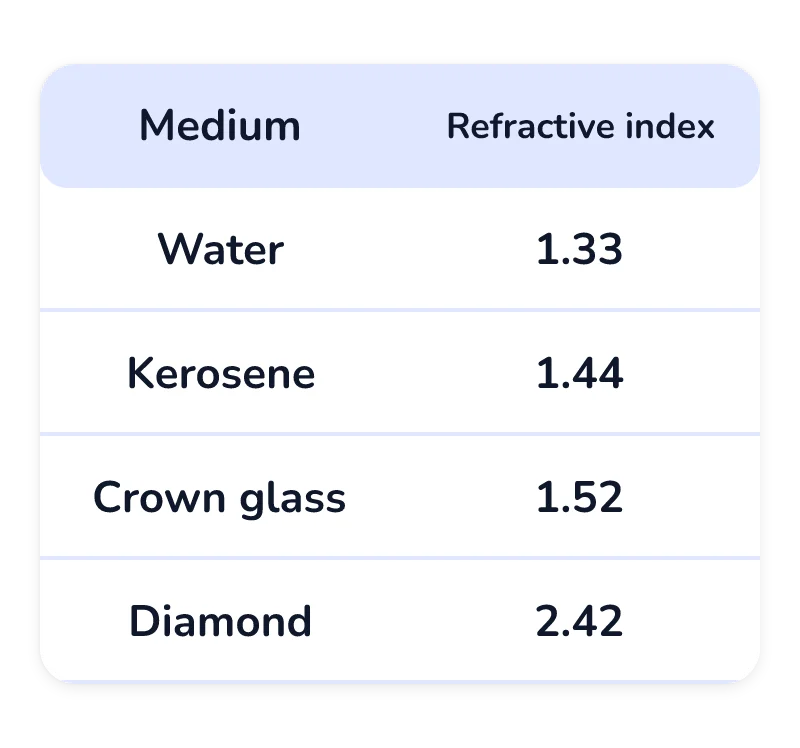
The table gives the refractive index of four media. About how many times faster does light travel in water than in diamond?
AAbout 0.55 timesBAbout 3.75 timesCAbout 1.1 timesDAbout 1.8 times - 6Question 6
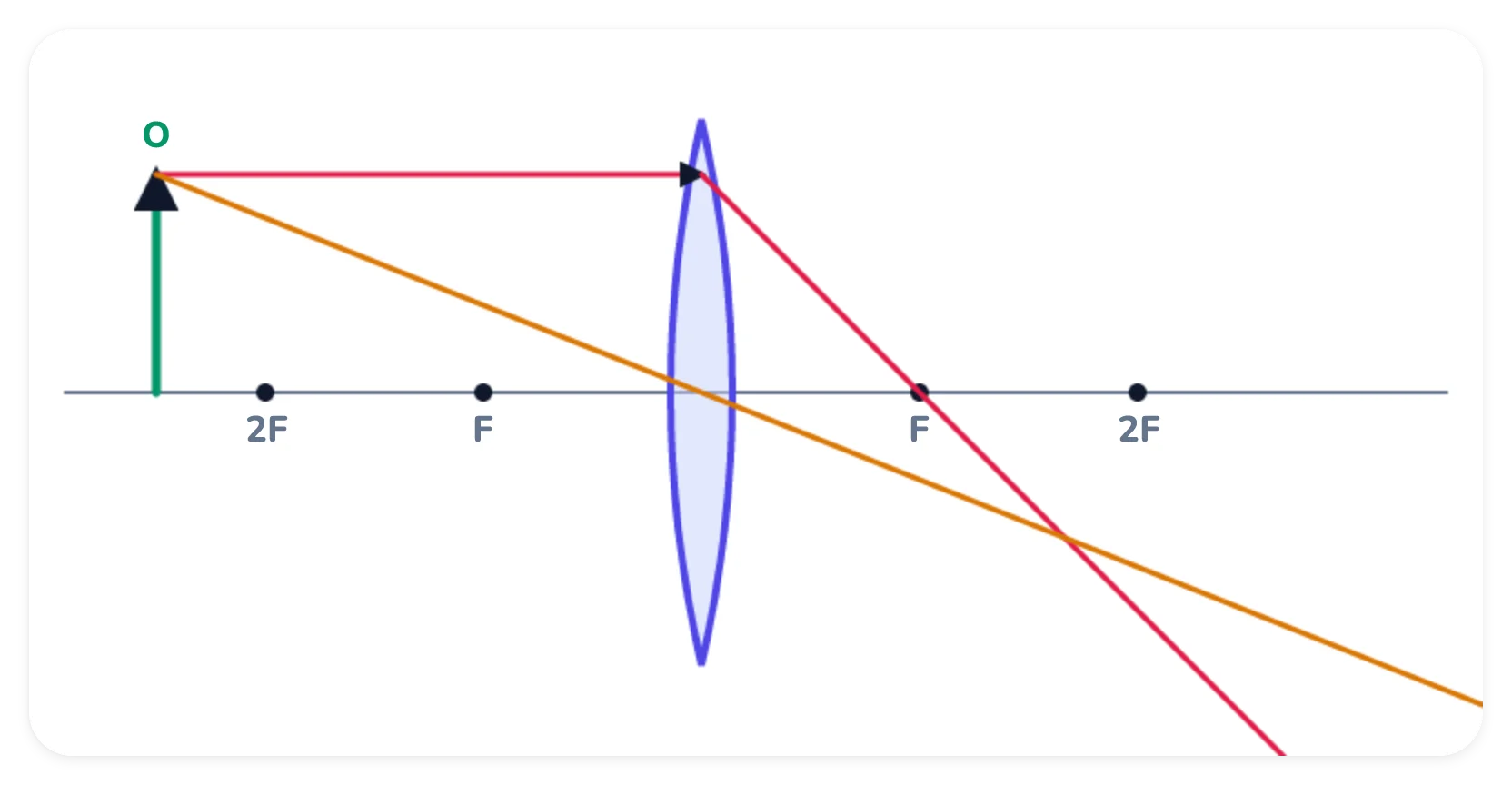
The diagram shows an object placed beyond 2F in front of a convex lens. Where is the image formed, and what is it like?
ABetween F and 2F on the other side, real, inverted and diminishedBBeyond 2F on the other side of the lens, real, inverted and highly magnifiedCAt 2F on the other side, the same sizeDOn the same side as the object, virtual and erect - 7Question 7
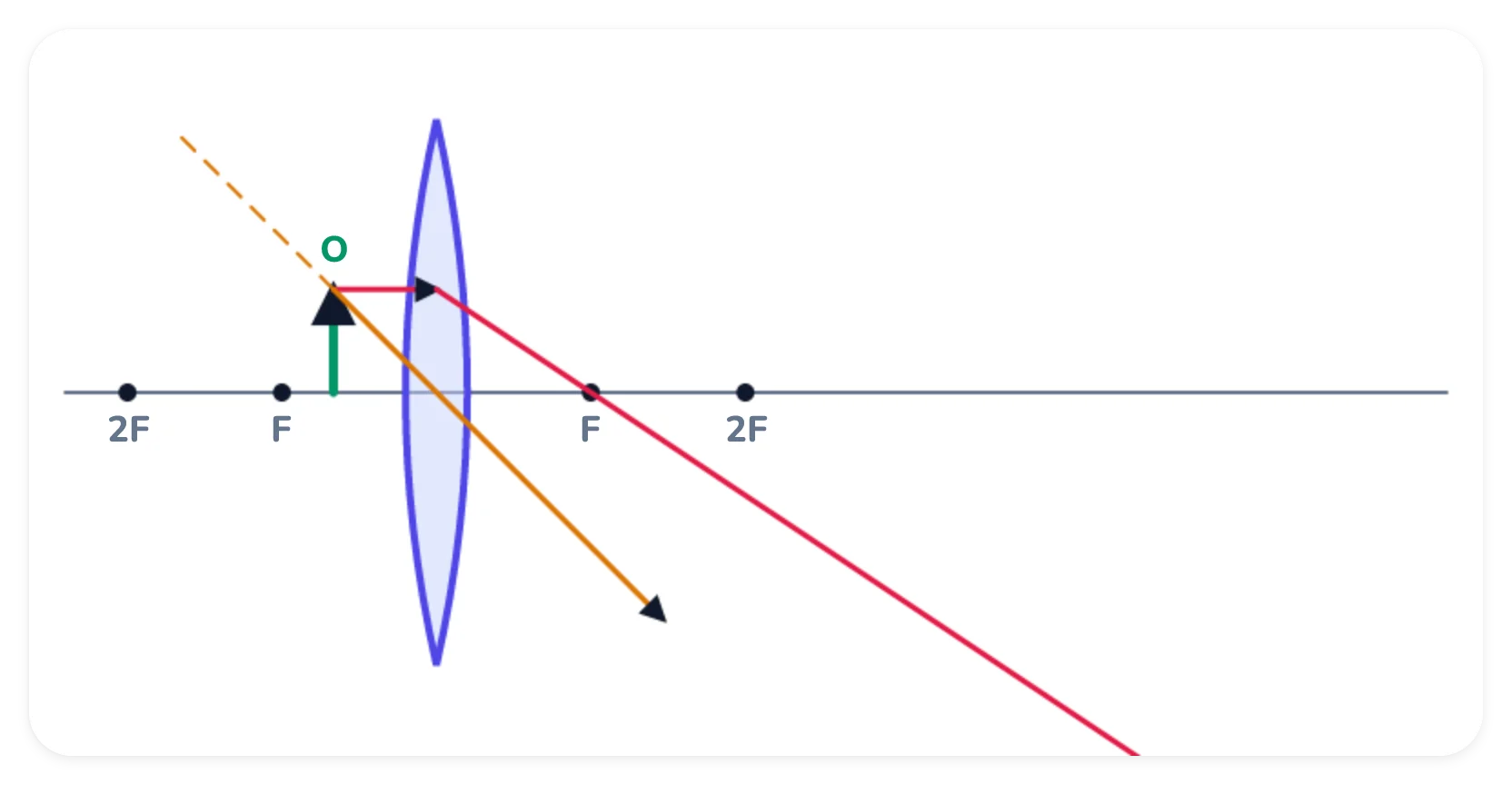
The diagram shows an object placed between the optical center and F of a convex lens. Where is the image formed, and what is it like?
ABeyond 2F on the other side, real and invertedBAt infinityCOn the same side as the object, virtual, erect and magnifiedDBetween F and 2F on the other side of the lens, real, inverted and diminished - 8Question 8
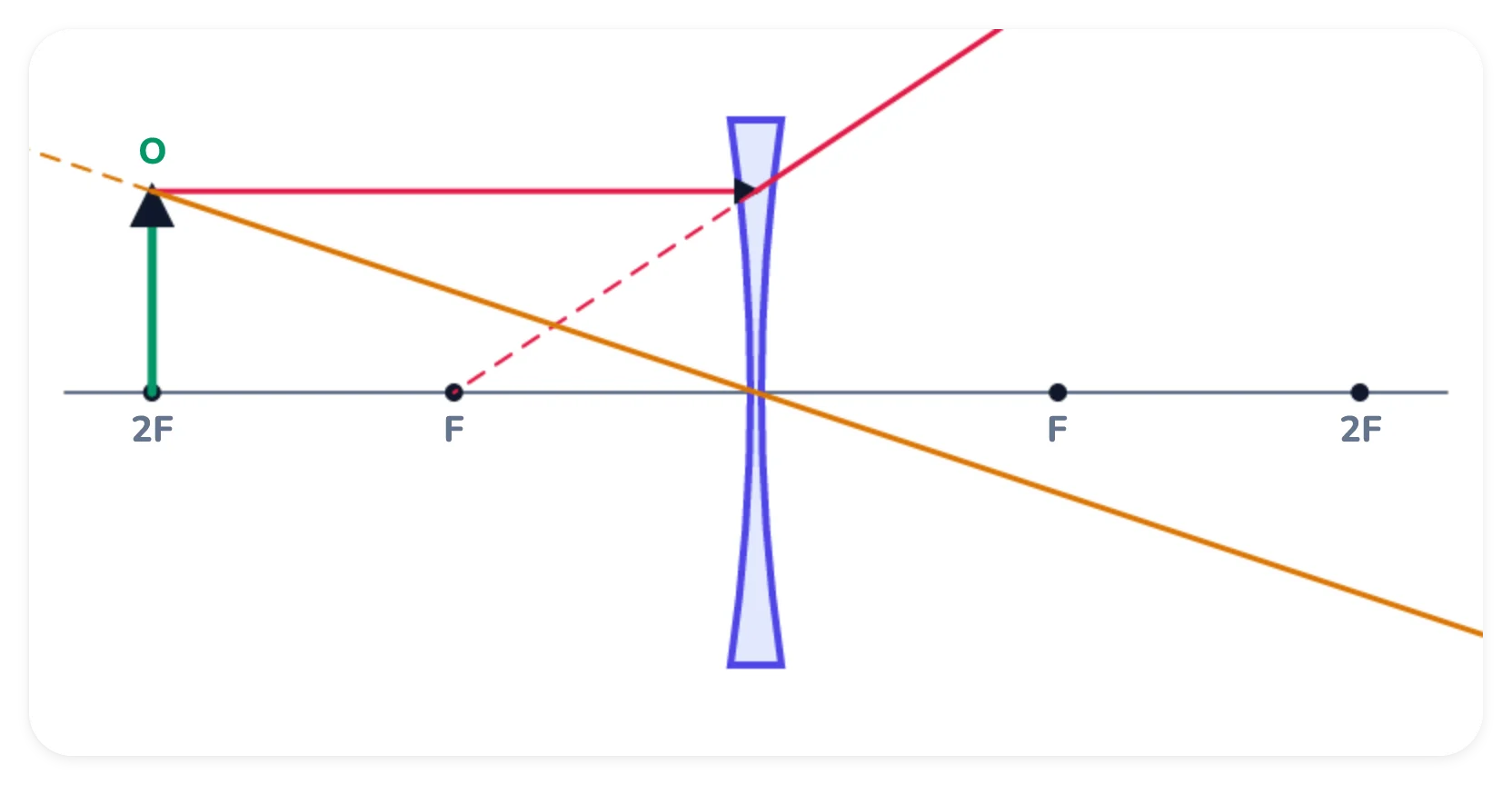
The diagram shows an object in front of a concave lens. Where is the image formed, and what is it like?
AOn the other side of the lens between F and 2F, real, inverted and slightly diminishedBBetween F and the optical center on the same side, virtual, erect and diminishedCAt 2F on the same side, virtual and magnifiedDAt F on the other side, highly diminished - 9Question 9
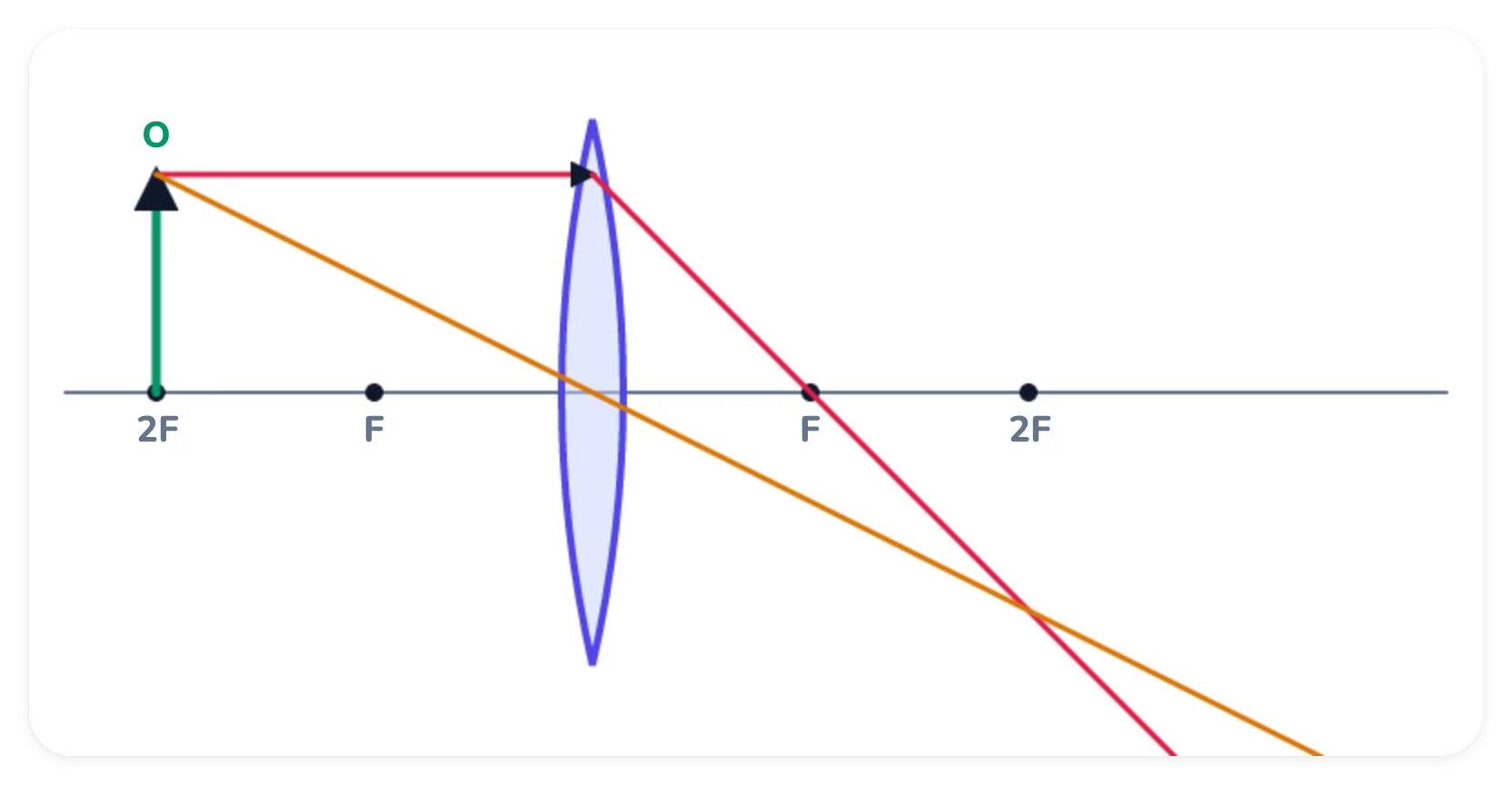
The diagram shows an object placed exactly at 2F in front of a convex lens. Where is the image formed, and what is it like?
AAt F on the other side, diminishedBAt 2F on the other side, real, inverted and the same sizeCBeyond 2F on the other side of the lens, real, inverted and magnifiedDAt 2F on the same side, virtual and erect - 10Question 10
A ray of light passes through a rectangular glass slab. How does the emergent ray compare with the incident ray?
AIt is parallel to the incident ray but shifted sidewaysBIt bends toward the normal and stays bentCIt is deviated by exactly twice the angle of incidence at the first faceDIt is reflected back along its own path - 11Question 11
To use a convex lens as a magnifying glass, where must the object be placed?
AAnywhere beyond 2F on the principal axisBBetween F and 2FCBetween the optical center and FDExactly at F - 12Question 12
A lens is thicker at the edges than in the middle. What kind of lens is it, and what does it do to parallel rays?
AA convex lens; it converges them to a single point called the principal focusBA plane lens; it leaves them parallelCA concave lens; it diverges them so they appear to come from a focusDA convex lens; it diverges them
Want one of your own?
Start with an idea, a document, or a little curiosity. We’ll make the quiz together.